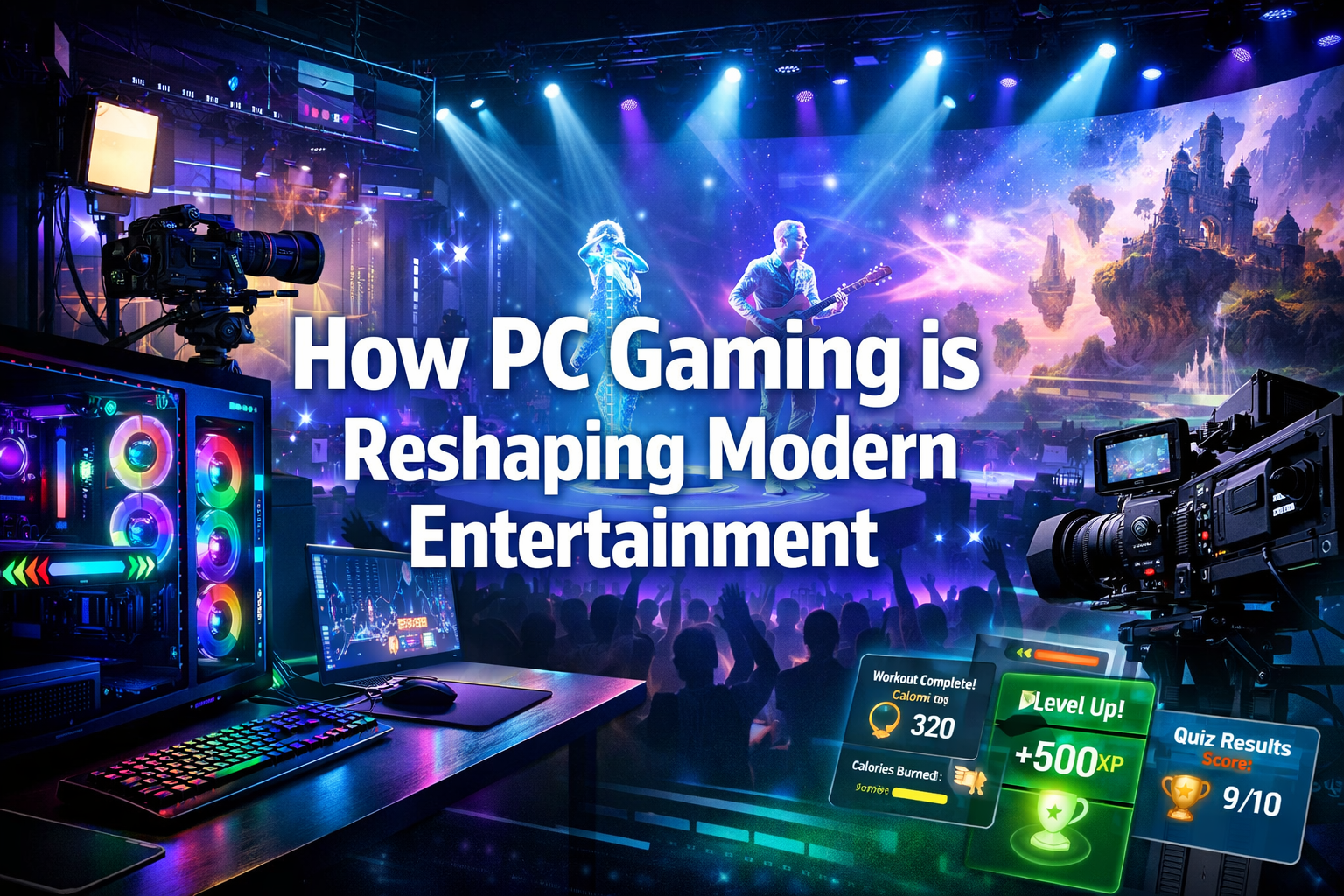
Long gone are the days that PC gaming was a niche hobby. Now, in 2026, it’s a powerhouse of modern entertainment that wields influence in multiple different sectors, fundamentally reshaping modern entertainment. In some places, the effect of PC gaming is obvious; in others, it requires a closer look before it becomes apparent. Today, we’ll explore how the impact of PC gaming echoes across a diverse range of entertainment forms, from film and television to music, demonstrating how PC gaming is truly at the forefront of this digital transformation. Strap yourself into your favourite gaming chair and read on.
Key Takeaways
PC gaming technology and design principles are transforming diverse entertainment sectors, from online games and music to fitness and education.
The rise of esports has elevated competitive gaming into a global spectator sport, creating new professional opportunities and entertainment avenues.
Filmmaking is adopting real-time rendering and virtual production techniques pioneered in PC gaming, enabling unprecedented creative flexibility.
Gamification elements, refined in PC gaming, are increasingly used in social media, fitness apps, and educational platforms to boost engagement.
While offering exciting possibilities, the pervasive influence of PC gaming also brings challenges related to addiction, privacy, and security across various digital platforms.
The Digital Entertainment Revolution: How PC Gaming is Reshaping Online Worlds
To those unfamiliar with online entertainment platforms, this might seem like an unusual place to observe the impact of PC gaming. Yet, here lies one of the most compelling examples of its influence. While these platforms may resemble their traditional, real-world counterparts, they have evolved into versatile forms of digital entertainment, fully utilizing the possibilities of their virtual environments. This transformation has been significantly shaped by the adoption of technology and design principles first pioneered in the world of PC gaming.
Have you played a modern online game lately? They boast graphics that could rival contemporary video game consoles. It’s a far cry from the rudimentary digital slot machines of the early internet era. Now these games have fleshed-out characters and 3D worlds not dissimilar from an open-world juggernaut. This visual realisation follows on from the pursuit of photorealism that first emerged in PC gaming, which pushed the boundaries of computer graphics past where anyone initially thought they could go. This relentless pursuit of visual fidelity in PC games has set a new standard for all forms of digital entertainment, driving innovation in rendering, animation, and environmental design.
If you visit the best crypto casino UK platforms have to offer, you’ll find more than simple aesthetic majesty. The complex algorithms powering modern games – from physics simulations to AI behaviour – are being adapted to create more engaging games. Random Number Generators (RNGs), the backbone of digital gaming, have grown increasingly sophisticated, borrowing techniques from procedural generation methods used in PC games. This adoption of advanced algorithmic design, honed in complex PC game environments, allows for richer, more unpredictable, and ultimately more replayable experiences across a spectrum of online entertainment.
The incorporation of game-like elements in online platforms—such as achievement systems, progress bars, and narrative features—is directly inspired by video games. These elements, originally refined in PC gaming, are now being used to create more engaging experiences on various digital platforms, blurring the line between traditional gaming and other online activities. Cryptocurrency-based platforms are at the forefront of this trend. By utilizing blockchain technology to offer users enhanced transparency and security, they are attracting tech-savvy PC gamers. This blend of gamification and cutting-edge financial technology illustrates how PC gaming’s influence extends beyond mere entertainment into nascent economic models. The ability to own unique in-game assets as NFTs, for instance, directly appeals to a generation accustomed to digital ownership and in-game economies.
Evolving Gaming Platforms: A New Era of Immersion
Beyond just aesthetics and algorithms, the very architecture of online gaming platforms reflects PC gaming’s influence. Server infrastructure, network optimization, and anti-cheat systems have all evolved dramatically, driven by the demands of massive multiplayer PC titles. This robust foundation is now a prerequisite for any serious online entertainment venture, from virtual worlds to interactive streaming events. The emphasis on low latency and high bandwidth, critical for competitive PC gaming, has become a benchmark for all digital interactions, ensuring seamless experiences for users worldwide.
The Music Industry’s Game Change
The music industry has been taking notes on PC gaming for a long time. Beyond game soundtracks, you can see the influence in the rise of virtual concerts, popularised by platforms like Fortnite. These have opened avenues for artist-fan interactions that don’t require leaving the comfort of your own home. What’s more, they don’t price fans out of feeling involved in their idol’s music. These events owe their existence to the robust multiplayer infrastructure developed for PC games, which can handle millions of simultaneous users in a single virtual space.
“PC gaming has opened up entirely new performance spaces for musicians, transforming how artists connect with their audience and pushing the boundaries of what a ‘concert’ can be.”
Additionally, music production software has adopted interfaces and workflows inspired by game design principles, making complex tools more accessible to amateur producers. The gamification of music learning apps, using achievement systems and progress tracking, also bears the unmistakable mark of PC gaming influence. This blend of creative tools with engaging feedback mechanisms fosters a new generation of musicians. The collaborative features often found in PC games, allowing players to build and create together, are also influencing music creation, with platforms emerging that enable shared music production in real-time virtual environments.
Fitness Gets Gamified: How PC Gaming is Reshaping Well-being
The fitness industry has used gamification principles straight from the PC gaming playbook to great effect. It’s common for fitness apps and equipment to now feature achievement systems, like telling you when you’ve achieved a new personal best in a particular exercise. It’s not unlike seeing your character progress in a video game. This element shouldn’t be overlooked as it’s allowing users to look at themselves in a different light, to imagine an avatar of themselves that they’d one day like to be. Believing that they’re on a journey to reaching that ultimate goal – perhaps benching 100kg – keeps them engaged and motivated.
This psychological impact, often associated with the reward loops in PC games, is incredibly powerful. Leaderboards, social challenges, and unlockable content (like new workout routines or cosmetic items for your digital avatar) all drive consistent participation. Beyond apps, interactive fitness devices, from smart bikes to virtual reality headsets, leverage PC gaming technology to create immersive exercise experiences that turn workouts into engaging adventures. Think of running through a virtual landscape or sparring with an AI opponent – these are direct descendants of PC gaming innovation.
The Rise of Exergaming: Blurring Lines
Exergaming, which blends exercise with video games, is a growing segment directly influenced by PC gaming. Products like VR fitness games transport users to virtual worlds where physical activity is integrated seamlessly into gameplay. This not only makes exercise more enjoyable but also helps overcome common barriers to traditional fitness, particularly for those who find gyms intimidating or monotonous. The advanced motion tracking and haptic feedback developed for PC gaming peripherals are crucial to the success of these applications, providing a truly immersive and effective workout.
Education: Learning Through Play
Educational technology owes a debt of gratitude to PC gaming. E-learning platforms like Duolingo increasingly use game-like elements to enhance engagement and retention. There are levels that players can reach individually and they can compare themselves to friends and strangers alike on leaderboards. In more academic environments, simulations and virtual labs, the staples of many educational software packages, leverage PC technologies to create immersive learning environments. These interactive tools allow students to conduct experiments, explore complex systems, and even perform virtual dissections in a safe, repeatable, and engaging manner.
The concept of “serious games” – video games designed for a primary purpose other than pure entertainment, such as training or education – is also a direct outgrowth of PC gaming. These applications are used in fields ranging from medical training to military simulations, providing realistic, hands-on experience without real-world risks. The underlying graphics engines, physics simulations, and AI behaviors developed for high-end PC games are now repurposed to build sophisticated educational tools that accelerate learning and skill development. The ability to fail safely and learn from mistakes within a virtual environment, a core tenet of many PC games, is proving invaluable in education.
The Rise of Esports: How PC Gaming is Reshaping Competitive Sports
Perhaps the most direct extension of PC gaming’s influence is the burgeoning world of esports. This phenomenon has transformed competitive gaming into a global spectator sport, complete with professional leagues, massive tournaments, and millionaire players. The infrastructure supporting esports – from streaming platforms to analytics tools – has roots in PC gaming technology. Live streaming, pioneered by PC gamers on platforms like Twitch, has become a mainstream entertainment medium, attracting millions of viewers and establishing new revenue streams for content creators.
Esports athletes are now recognized as legitimate sports figures, often undergoing rigorous training regimes, working with coaches, and competing for prize pools that rival traditional sports. Major corporations, media outlets, and even educational institutions are investing heavily in esports, recognizing its immense cultural and economic potential. This shift underscores PC gaming’s power not just as a pastime, but as a legitimate career path and a significant contributor to the global entertainment economy. The sophisticated networking, high-performance hardware, and demanding graphical fidelity of competitive PC games are the bedrock upon which this entire industry is built.
Esports as a Cultural Phenomenon
The cultural impact of esports is undeniable. It has fostered dedicated fan bases, created unique subcultures, and provided a platform for global competition that transcends geographical boundaries. Esports events fill arenas, generate massive online viewership, and inspire communities of players and fans worldwide. This level of engagement rivals traditional sports and demonstrates the profound influence of PC gaming on how we define and consume competitive entertainment in 2026. The narratives of triumph and defeat, the underdog stories, and the rivalries between top teams resonate deeply with audiences, much like any other major sport.
Cinematic Transformations: How PC Gaming is Reshaping Filmmaking
The film industry often leans heavily on themes associated with the world of PC gamers. Think of the tropes you’ve seen a thousand times before, perhaps where a ‘nerdy’ gamer is enlisted by cool jocks who want them to ‘hack into’ a database. These skills don’t always transfer over to hacking, but we’ll try to take it as a compliment all the same. The influence of PC gaming goes beyond that, though, and into the filmmaking process itself. Once, visual effects were the domain of specialised studios. Now, however, real-time rendering technologies which were first developed for games are commonly used in productions like “The Mandalorian.“
This development is genuinely ground-breaking. Through a technique known as virtual production, filmmakers can now shoot on massive LED screens, with the background perfectly replacing the real shoot. This means that time is no longer an issue for shooting in a particular light, and entire worlds can be created and manipulated in real-time, on set. Directors can instantly adjust environments, lighting, and even the time of day, offering unprecedented creative control and efficiency. This technology, largely powered by game engines like Unreal Engine, allows for complex visual effects to be integrated during principal photography, reducing post-production time and costs significantly.
The movie industry is also borrowing the narrative structures of games. Non-linear storytelling, multiple endings, and interactive elements – all staples of modern PC games – are finding their way into traditional media. Netflix’s “Bandersnatch” and other interactive films represent early experiments in this convergence, allowing viewers to make choices that influence the plot. This trend is only likely to grow, as audiences increasingly expect more personalized and participatory entertainment experiences, a demand largely cultivated by years of engaging with interactive PC games. The ability to put the viewer in the director’s seat, even in a limited capacity, fundamentally changes the consumption of narrative media.
Beyond the Screen: Virtual Storytelling
The impact extends to pre-visualization and concept art, where game engines are used to rapidly prototype scenes, camera angles, and character movements before a single frame is shot. This iterative process, common in game development, brings a new level of efficiency and creative freedom to film production. Furthermore, immersive experiences built with VR/AR technology, directly drawing on PC gaming’s expertise in virtual environments, are paving the way for entirely new forms of interactive storytelling that blur the lines between film, theatre, and gaming.
Social Media’s Gamified Engagement
Even social media platforms haven’t escaped the influence of PC gaming. Features like streaks, achievements, and level-up systems on platforms like Snapchat and LinkedIn are borrowed directly from game design principles. These elements, proven effective in keeping gamers engaged, are now used to drive user engagement across various social platforms. The dopamine hit of earning a badge or maintaining a “streak” leverages the same psychological principles that keep players coming back to their favorite PC games.
The desire for social validation, another key driver in multiplayer PC gaming, is mirrored in the likes, shares, and comments that fuel social media interaction. The continuous feedback loops, leaderboards comparing user activity, and virtual rewards all contribute to a gamified experience designed to maximize time spent on these platforms. This demonstrates a deep understanding of human psychology, initially explored and refined within the competitive and engaging landscapes of PC gaming.
The Attention Economy: A Gamified Landscape
In the attention economy of 2026, every click, scroll, and interaction is a valuable commodity. Social media platforms, by adopting gamification elements from PC gaming, are strategically engineering engagement. From “likes” as experience points to “followers” as in-game currency, the parallels are striking. This isn’t just about making platforms more fun; it’s about making them more sticky and habit-forming, transforming casual browsing into a continuous quest for digital rewards and recognition.
Challenges and Considerations
While the influence of PC gaming on various entertainment sectors offers exciting possibilities, it also presents challenges. Issues of addiction, previously associated mainly with games, are now concerns in gamified apps and platforms across different industries. The immersive nature of these experiences, enhanced by gaming technologies, can potentially lead to unhealthy usage patterns. As engagement becomes a primary metric, the ethical responsibility of designers to mitigate potential harm becomes paramount.
“The very mechanisms that make PC gaming so engaging are now being applied across all forms of entertainment, necessitating a greater focus on user well-being and responsible design.”
Privacy and security concerns also loom large, particularly as more platforms adopt online multiplayer infrastructures similar to those in PC gaming. The need for robust security measures, akin to those developed for protecting valuable in-game assets and user data in competitive PC titles, is becoming crucial across various entertainment sectors. With sensitive personal information often shared on these platforms, and the increasing integration of financial transactions (like those in crypto-based games), the stakes for data breaches and cyber-attacks are higher than ever. Ensuring the integrity and confidentiality of user data is a complex challenge that grows with the expanding reach of PC gaming technologies.
Moreover, the digital divide remains a significant consideration. While PC gaming has made entertainment more accessible in some ways, the high cost of entry for state-of-the-art gaming PCs and high-speed internet can exclude certain demographics from fully participating in this evolving landscape. Bridging this gap is essential to ensure that the benefits of this digital transformation are broadly shared.
Conclusion
The influence of PC gaming on modern entertainment is profound and far-reaching. From online games to Hollywood, from virtual concerts to fitness apps, the technological innovations and design principles of PC gaming are reshaping how we interact with media and each other. As this trend continues, we can expect to see even more convergence between traditional entertainment forms and interactive, game-like experiences. The challenge for industry stakeholders will be to harness these technologies responsibly, ensuring that the pursuit of engagement doesn’t come at the cost of user well-being. This requires proactive development of ethical guidelines and safeguards to protect consumers in an increasingly gamified world.
For consumers, this new landscape offers more immersive, interactive, and personalized entertainment options than ever before. However, it also demands a greater degree of media literacy and self-awareness. As the lines between different forms of entertainment continue to blur, the ability to engage with these platforms in a healthy and informed manner becomes increasingly important. Understanding the persuasive design tactics and the potential for over-engagement is key to navigating this exciting, yet complex, digital ecosystem.
The fusion of PC gaming with other forms of entertainment is neither inherently positive nor negative. Like all technological shifts, its impact will depend on how it’s implemented and used. As we navigate this new era of digital entertainment, the onus is on creators, regulators, and users alike to shape a future that maximizes the benefits of these innovations while mitigating their potential risks. By fostering transparency, promoting responsible design, and educating users, we can ensure that PC gaming’s transformative power continues to enrich modern entertainment in a sustainable and beneficial way for everyone. The journey of how PC gaming is reshaping modern entertainment is far from over; it is an ongoing evolution that promises to continue innovating and surprising us for years to come.
Frequently Asked Questions about PC Gaming’s Influence
Q: How has PC gaming impacted the music industry?
A: PC gaming has influenced the music industry through virtual concerts (like those in Fortnite), inspiring music production software interfaces, and gamifying music learning apps with achievement systems and progress tracking. The robust multiplayer infrastructure developed for PC games enables large-scale virtual events.
Q: What is “gamification” and how does PC gaming relate to it?
A: Gamification is the application of game-design elements and game principles in non-game contexts. PC gaming is directly related because it pioneered many of these elements, such as achievement systems, leaderboards, and reward loops, which are now widely adopted in fitness apps, educational platforms, and social media to increase engagement and motivation.
Q: How are PC gaming technologies being used in filmmaking?
A: PC gaming technologies, particularly real-time rendering and game engines, are transforming filmmaking through virtual production. This allows filmmakers to create and manipulate virtual backgrounds on LED screens in real-time on set, offering unprecedented creative control and efficiency. Game-inspired narrative structures, like non-linear storytelling, are also finding their way into interactive films.
Q: What are the main challenges associated with PC gaming’s growing influence?
A: Key challenges include concerns about addiction, as gamified engagement features can lead to unhealthy usage patterns across various platforms. Privacy and security are also major concerns, especially with the adoption of online multiplayer infrastructures and integrated financial transactions, necessitating robust security measures to protect user data and assets.
Understanding Modern Entertainment: Key Terms Defined
Gamification
The application of game-design elements and game principles in non-game contexts, such as fitness apps, educational software, or social media, to enhance user engagement and motivation. This concept heavily draws from principles refined in PC gaming.
Virtual Production
A filmmaking technique that uses real-time rendering technologies, often powered by game engines, to create and display digital backgrounds on large LED screens on set. This allows directors to interact with virtual environments during filming, significantly reducing post-production time and increasing creative flexibility. It’s a direct application of PC gaming graphics advancements.
Esports
Short for electronic sports, esports refers to organized competitive video gaming, typically between professional players or teams. It has grown into a global phenomenon with leagues, tournaments, and significant prize pools, directly stemming from the competitive multiplayer landscape of PC gaming.
Procedural Generation
A method of creating data algorithmically rather than manually. In PC gaming, it’s used to generate vast game worlds, quests, or content automatically. Its techniques are now being adapted in other digital entertainment, such as for sophisticated Random Number Generators (RNGs) in online games, to create more varied and engaging experiences.
How to Leverage PC Gaming’s Influence in Your Projects
1 Integrate Gamification Elements
Identify core user actions and integrate achievement systems, progress bars, or leaderboards. For instance, a learning app could award badges for completing lessons, or a productivity tool could offer “level ups” for consistent task completion. Draw inspiration from popular PC game mechanics that drive long-term engagement.
2 Adopt Real-Time Rendering for Visuals
For visual projects like film, animation, or architectural visualization, explore using game engines (e.g., Unreal Engine, Unity) for real-time rendering. This can significantly speed up your workflow, allow for iterative design changes on the fly, and enable virtual production techniques for more immersive and flexible content creation.
3 Build Community with Multiplayer Mechanics
If your project involves social interaction, consider implementing robust multiplayer infrastructure and community features akin to those in PC games. This includes efficient networking, communication tools, and social grouping options to foster strong user communities and enable shared, interactive experiences, like virtual events or collaborative creative spaces.
4 Embrace Interactive Narrative Structures
For storytelling, move beyond linear narratives by incorporating choice-based elements, branching storylines, or multiple endings. This approach, refined in PC role-playing games and adventure titles, gives audiences greater agency and replayability, catering to a demand for personalized and immersive storytelling experiences.
5 Prioritize User Experience and Performance
Emulate PC gaming’s emphasis on responsive interfaces, optimized performance, and low latency. Whether it’s an app or a website, ensure a smooth, intuitive, and fast user experience. Regular updates, bug fixes, and performance tuning, common in PC game development, are crucial for maintaining user satisfaction and competitive edge.
Marcin Wieclaw, the founder and administrator of PC Site since 2019, is a dedicated technology writer and enthusiast. With a passion for the latest developments in the tech world, Marcin has crafted PC Site into a trusted resource for technology insights. His expertise and commitment to demystifying complex technology topics have made the website a favored destination for both tech aficionados and professionals seeking to stay informed.