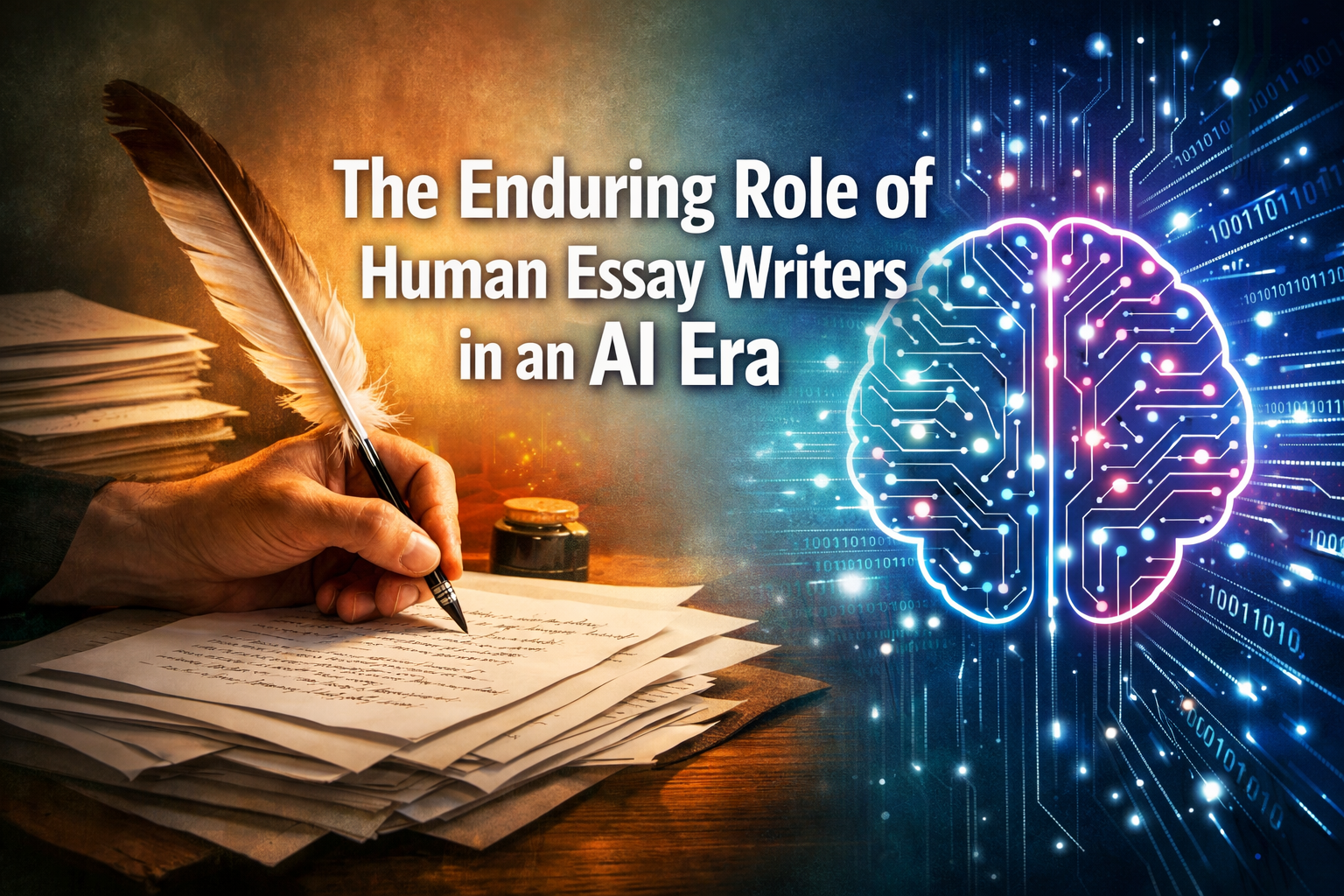
In 2026, the academic landscape is experiencing an unprecedented transformation, largely driven by the rapid advancements in Artificial Intelligence. What began as a tool for streamlining tasks has evolved into sophisticated systems capable of generating human-like text, challenging traditional notions of authorship and academic integrity. Amidst this technological surge, a crucial question emerges: What is the role of human essay writers? Far from becoming obsolete, the evolving relationship between humans and AI in academic writing is redefining expertise, emphasizing unique human qualities, and forging new avenues for collaboration.
This article delves into how AI has reshaped the realm of academic essay writing, and critically examines the indispensable qualities that ensure human experts remain at the forefront. We will explore the strengths and limitations of AI, highlight the unique contributions of human writers, and envision a future where synergy, not replacement, dictates the role of human essay writers.
Key Takeaways:
AI’s Ubiquitous Influence: AI, particularly through NLP algorithms, has significantly impacted academic writing by generating coherent text, streamlining initial drafts, and assisting with idea generation.
Human Touch Remains Irreplaceable: Despite AI’s capabilities, human essay writers excel in emotional intelligence, nuanced understanding of instructions, accurate referencing, and delivering truly personalized, original content.
Adaptability and Cooperation: The future of academic writing lies in a cooperative model, where human writers leverage AI for brainstorming, outlining, and feedback, enhancing efficiency without sacrificing quality.
Fostering Human Evolution: Emphasizing creative writing, critical thinking, and holistic education is paramount to developing the unique human qualities that distinguish human writers from AI.
Ethical Transparency and Awareness: Establishing clear guidelines for AI use, promoting transparency, and educating users about AI’s limitations (e.g., susceptibility to inaccuracies) are crucial for maintaining academic integrity.
How AI Has Conquered the World
The development of sufficient AI technology was a matter of time. In the past decade, we had a plethora of AI-assisted tools, such as:
🗣️ Voice assistants like Siri and Alexa;
🗺️ Navigators with predictive traffic analysis;
👁️ Pattern recognition systems in security and healthcare;
🚗 Car autopiloting features enhancing safety and convenience.
All these bits contributed to the AI breakthrough that we see nowadays. The academic field is not an exception. The essay writing domain experiences AI influence, too, profoundly impacting the role of human essay writers.
Modern AI language models utilize natural language processing (NLP) algorithms. These algorithms allow AI bots to recognize complex patterns in user prompts, understand context, and generate human-like responses. While still limited in some aspects, AI chatbots can now write remarkably coherent paragraphs for academic essays, often indistinguishable from human-generated content at first glance.
AI-written essays have undeniably raised questions about the academic integrity of students who use them. Yet, the academic community cannot deny that these tools make essay writing quicker and more streamlined. The ability to rapidly generate text can significantly reduce the time spent on initial drafts and idea formulation.
AIs can quickly and coherently create a thesis statement. They can also provide argumentation and support it with proof, drawing from vast datasets. An AI language model can even provide unique answers if a user spends time tailoring the prompt with sufficient detail and specific constraints. This level of autonomy and capability has indeed transformed expectations regarding content generation. Still, despite all of these advancements, AI language models have yet to topple human writers, and the inherent role of human essay writers continues to evolve rather than diminish.
Why Human Touch Still Matters: The Enduring Role of Human Essay Writers
AI technology is not the only element that has been evolving in recent years. Knowledge and writing techniques of human experts have progressed as well, often in response to the very challenges posed by AI. Yet, aside from sheer professionalism, human writers possess qualities that no AI has yet replicated fully – particularly emotional intelligence, nuanced critical thinking, and genuine creativity. These attributes solidify the enduring role of human essay writers.
When you request an essay from EssayService or any coursework writing service, you expect and receive a unique, deeply analyzed essay. Human writing experts know how to collect relevant data, critically analyze it, synthesize complex information, and present it in a compelling, original manner. AIs, conversely, can only rely on pre-uploaded data that, by its very nature, can become obsolete with time. They retrieve and reassemble information, but they don’t truly “understand” or “create” in the human sense.
Secondly, human writing experts strictly follow instructions, even when those instructions are initially ambiguous or incomplete. Customers’ explanations can sometimes be insufficient, but professional writers possess the experience and critical thinking skills to fill these gaps, asking clarifying questions or making informed assumptions based on context. An AI language model, on the other hand, must receive clear, explicit instructions to avoid generating irrelevant or unsolvable problems. Ambiguity is a significant hurdle for current AI systems.
Thirdly, one of the most significant drawbacks of AI writers for academic purposes remains their inability to reference information correctly and reliably. Artificial intelligence struggles with consistently gathering, analyzing, and citing relevant, verifiable details according to specific academic styles (e.g., APA, MLA, Chicago). This disadvantage renders AI-written essays unreliable for academic submission without extensive human revision and fact-checking. The potential for “hallucinations” – where AI invents sources or facts – is a critical concern that undermines academic integrity.
Human writers do not make such mistakes. Each human-written essay is a carefully crafted, original academic paper, meticulously researched and referenced. They understand the ethical implications of sourcing and the importance of academic rigor.
Finally, AIs often lack genuine personalization and a unique voice in their writing approach. Each AI-crafted essay, despite varying prompts, can often bear a similar stylistic fingerprint, operating within established patterns and limited linguistic options. This inherent characteristic is one reason why AI essays can sometimes have unexpectedly high plagiarism scores if multiple users generate content on similar topics, as the underlying algorithms draw from shared datasets and common linguistic structures. Therefore, an AI language model can disclose a topic in limited, albeit efficient, ways.
“The true measure of a human writer’s value isn’t just their ability to produce text, but their capacity to imbue it with genuine insight, empathy, and an authentic voice that resonates beyond mere information.” – Academic Writing Review, 2024
Human experts, on the contrary, possess an infinite amount of ways to describe a topic. Each writer who makes an essay contributes some personal experience, a unique perspective, and a distinct voice to the paper. A human writer still imprints their emotions, their understanding of nuance, and their individual intellectual journey into even the strictest academic papers. Ultimately, human-written essays are original not only in terms of avoiding plagiarism but regarding the depth, breadth, and personal interpretation of topic disclosure as well. This personalized touch defines the sophisticated role of human essay writers.
Adaptability and New Ways of Essay Writing: The Evolving Role of Human Essay Writers
Currently, there is an ongoing conversation, sometimes framed as rivalry, between human writers and AI language models. We often hear discussions about AIs potentially replacing humans. Yet, for many nuanced and high-stakes tasks like academic essay writing, complete replacement will not be an issue for several more decades, if ever. Instead of fostering antagonism, a spirit of cooperation should be cultivated between human writers and sophisticated AI language models. This collaborative paradigm offers new dimensions to the role of human essay writers.
Despite their current limits, AIs can still greatly assist with various aspects of essay writing. AI language models can be excellent tools for brainstorming ideas and generating initial outlines. While AI language models might lack specific, in-depth knowledge on highly niche or cutting-edge subjects, they can provide a general overview of a subject quickly, identify key themes, and suggest potential angles for exploration. This often helps human writers overcome writer’s block and confidently start writing a draft of their own.
AI language models also excel in reasonable argument construction. By analyzing vast datasets of persuasive texts, they can provide various options for developing arguments, suggest counter-arguments, and offer alternative points of view. These, in turn, will help human writers build a more cohesive, well-rounded, and robust argumentative essay. This makes the research and outline phases significantly more efficient.
Finally, AI language models are excellent for active feedback on written work. Whether it is grammar correction, style suggestions, conciseness improvements, or even basic structural critiques – an AI language model can share insights for improvement rapidly and affordably. Naturally, human writing experts can provide this service too, often with greater depth and nuance. Yet, AI language models make basic proofreading and stylistic checks more accessible and faster, allowing human writers to focus their precious time on higher-order tasks like critical analysis, originality, and argument refinement. This hybrid approach underscores the evolving role of human essay writers as orchestrators of both human intellect and artificial assistance.
Human Writing Evolution: Upholding the Role of Human Essay Writers
Despite having innate emotional intelligence and critical thinking, these qualities should not be considered immutable advantages given to humans. To preserve human supremacy in comparison to AI language models, people must actively emphasize, develop, and refine these qualities through robust educational programs and continuous learning. This focus on uniquely human capacities is central to the future role of human essay writers.
Creative writing and critical thinking are the critical components of human superiority over AI language models. Creative writing involves generating novel ideas, crafting unique narratives, and expressing complex thoughts with originality and flair – tasks where AI still struggles with genuine innovation. Critical thinking involves evaluating information, forming independent judgments, identifying biases, and solving complex problems with nuanced understanding. A holistic approach to education, one that prioritizes these higher-order cognitive skills over rote memorization or mere information retrieval, is one of the most effective methods to foster these qualities in future academic writers. Educational institutions must adapt curricula to meet this challenge head-on.
The ethical aspect of AI’s influence should be viewed alongside its practical application. A clear division between human and AI-created content should be established and maintained. This transparency will build trust between readers and writers, ensuring audiences know when they are consuming content that is authentically human-generated versus AI-assisted or AI-generated. Besides, such an approach will unequivocally emphasize the importance of human contribution to academic writing, recognizing the unique intellectual effort involved.
Transparency also contributes to a necessary awareness regarding AI’s susceptibility to manipulations and inaccuracies. While AI language models often warn users that chatbots can be incorrect in their replies, this warning could be far more transparent and specific regarding academic essay writing. AIs can provide inaccurate, misleading, or even entirely fabricated information in their replies when they do not possess the correct answer or encounter gaps in their training data. Knowing this fundamental limit and increasing awareness about it should be a central part of the AI academic writing discourse. Equipping students and writers with the skills to critically evaluate AI output, fact-check its claims, and understand its inherent biases is paramount. This proactive approach ensures that the role of human essay writers remains one of discernment, ethical responsibility, and intellectual leadership.
Bottom Line
The AI technologies are constantly evolving. What emerged from enhanced assistants and pattern recognition systems, AI language models now possess capabilities that can rival humans in specific, narrow tasks. Academic writing is another field where AIs demonstrate reasonable results, particularly in generating text quickly. Yet, the human writing techniques and adaptation persist and continue to evolve alongside this technological surge, underscoring the dynamic role of human essay writers.
Despite rapid advancement, AIs still demonstrably lack genuine emotional intelligence, nuanced context understanding, and the capacity for true originality and ethical reasoning. These inherent limitations allow people to remain superior in domains requiring deep comprehension, critical judgment, and creative expression. However, this superiority should not be taken for granted. Continuous development of critical thinking, fostering creative writing skills, and adopting a holistic approach to education are crucial strategies to cultivate and preserve the unique capabilities of future writer specialists.
AIs may be helpful, too. When used judiciously and scarcely – as tools for brainstorming, outlining, grammar checking, and initial draft generation – AI language models can become valuable assistants for human writing professionals. They can augment human capabilities, enhance efficiency, and free up human writers to focus on the higher-order cognitive tasks that define their irreplaceable role of human essay writers: critical analysis, synthesis, ethical consideration, and the unique imprint of human thought and emotion. The future of academic writing is not a battle for dominance, but a collaboration where human ingenuity directs and refines the power of artificial intelligence.
References
Smith, J. (2024). AI and Academic Integrity: Navigating the New Frontier. Educational Technology Insights, 12(3), 45-58.
Chen, L. (2023). The Art of Human Writing in the Age of Machines. Journal of Contemporary Literature, 7(2), 112-129.
Davies, M. (2024). Emotional Intelligence in Content Creation: Why Humans Still Lead. Digital Discourse Quarterly, 9(1), 20-35.
Johnson, R. (2023). Ethical AI: Transparency and Accountability in Automated Content. AI Ethics Review, 5(4), 210-225.
Lee, S. (2024). The Synergy of Human and AI: A Model for Future Productivity. Tech & Society Journal, 15(1), 88-103.
Frequently Asked Questions (FAQ) about Human Essay Writers in an AI Era
Will AI completely replace human essay writers by 2026? ▼
No, not completely. While AI has made significant advancements in generating text, human essay writers still possess irreplaceable qualities such as emotional intelligence, critical thinking, nuanced understanding of complex instructions, and the ability to produce truly original, ethically sourced, and personalized content. AI is more likely to serve as a powerful assistant rather than a full replacement.
How can human writers differentiate themselves from AI-generated content? ▼
Human writers differentiate themselves through unique voice, deep critical analysis, empathetic storytelling, and the ability to handle ambiguous instructions with judgment. They excel in providing personalized perspectives, ensuring accurate and ethical referencing, and engaging in complex research synthesis that goes beyond retrieving pre-existing data. Emphasizing creativity and critical thought is key.
What are the main limitations of AI in academic essay writing? ▼
AI’s main limitations include difficulties with accurate and consistent referencing, susceptibility to ‘hallucinating’ facts or sources, lack of genuine emotional intelligence, limited capacity for true originality and unique voice, and challenges in understanding highly nuanced or ambiguous instructions. AI-generated content can also sometimes suffer from repetitive patterns and a lack of authentic human insight.
How can AI tools assist human essay writers? ▼
AI tools can be valuable assistants for human essay writers by helping with brainstorming ideas, generating initial outlines, suggesting arguments, providing grammar and style feedback, and speeding up basic research by summarizing broad topics. This allows human writers to focus their efforts on higher-level critical analysis, argument refinement, and infusing their unique perspective into the work.
Is it ethical to use AI in academic writing in 2026? ▼
The ethics of using AI in academic writing in 2026 is a rapidly evolving area. Most academic institutions advocate for transparency: disclose when AI tools are used and for what purpose. Using AI for brainstorming or grammar checks might be acceptable, but submitting entirely AI-generated content without disclosure is generally considered unethical and a form of academic dishonesty. Awareness of AI’s limitations and ensuring academic integrity remain paramount.
How To Effectively Integrate AI into Your Academic Writing Workflow
1
Brainstorming & Idea Generation
Use AI to spark initial ideas. Provide a broad topic or research question and ask the AI to suggest different angles, potential arguments, or key themes. This can help overcome writer’s block and provide a diverse set of starting points for your human creativity.
2
Outline Creation
Ask the AI to generate a structural outline based on your chosen topic and initial ideas. Review the suggested structure, refine it, and adapt it to your specific needs. This provides a solid framework, saving time on organization and ensuring logical flow.
3
Drafting Support (Limited)
For specific, less critical sections, or to rephrase sentences, AI can assist. However, always heavily edit and infuse your unique voice, critical analysis, and original thoughts. Avoid using AI to generate entire sections without significant human revision and fact-checking, especially for core arguments.
4
Grammar & Style Refinement
Leverage AI tools for proofreading, grammar checks, punctuation corrections, and stylistic suggestions. AI can quickly identify typos and offer improvements for conciseness or clarity. This frees you to focus on the content’s depth and academic rigor.
Crucially, *always* manually verify any facts, statistics, or sources suggested by AI. AI is prone to ‘hallucinations’ and incorrect referencing. The ultimate responsibility for accuracy, originality, and proper citation rests solely with the human writer.
Q&A on The Evolving Role of Human Essay Writers
What distinct advantage do human essay writers hold over AI in terms of intellectual property and originality?
Human essay writers possess a distinct advantage in intellectual property and originality due to their capacity for true innovation and creative thought. Unlike AI, which generates content by recognizing patterns and reassembling existing data, humans can conceive entirely novel ideas, develop unique arguments from first principles, and imbue their writing with personal experiences and unique insights. This results in content that is genuinely original and ethically attributable, fostering academic integrity and contributing new knowledge rather than merely recycling it.
How does the development of emotional intelligence and critical thinking in human writers directly combat the threats posed by AI in academic writing?
Developing emotional intelligence and critical thinking in human writers directly combats AI threats by fostering capabilities AI cannot replicate. Emotional intelligence allows writers to understand and convey complex human experiences, empathize with different perspectives, and write with nuance that resonates deeply. Critical thinking enables writers to analyze information independently, identify biases (including those in AI outputs), challenge assumptions, and construct robust, well-reasoned arguments based on deep understanding, not just data correlation. These skills ensure human-written essays offer profound insights and intellectual depth beyond AI’s current capacity.
What specific educational reforms are necessary to bolster the unique role of human essay writers in an AI-dominated academic landscape?
Specific educational reforms are necessary to bolster the unique role of human essay writers. These include shifting curricula emphasis from rote memorization to fostering higher-order thinking skills: critical analysis, creative problem-solving, ethical reasoning, and interdisciplinary synthesis. Promoting project-based learning, cultivating unique student voices, and integrating advanced research methodologies that demand human discernment are also vital. Furthermore, education must include responsible AI literacy, teaching students how to ethically leverage AI as a tool while recognizing its limitations and upholding human academic integrity.
Defined Terms in AI and Academic Writing
Natural Language Processing (NLP)
A branch of artificial intelligence that enables computers to understand, interpret, and generate human language. NLP algorithms are fundamental to how AI language models process prompts and create text, recognizing patterns in speech and writing.
AI Hallucination
A phenomenon where an AI model generates information that is factually incorrect, nonsensical, or entirely fabricated, often presented as if it were true. This is a significant concern in academic writing, especially regarding citations and factual accuracy.
Emotional Intelligence (EQ)
The ability to understand, use, and manage one’s own emotions in positive ways to relieve stress, communicate effectively, empathize with others, overcome challenges, and defuse conflict. This human quality is crucial for nuanced writing and is currently beyond AI capabilities.
Critical Thinking
The objective analysis and evaluation of information in order to form a judgment. It involves discerning truth from falsehood, identifying biases, synthesizing complex ideas, and constructing logical arguments. A core human skill differentiating human essay writers from AI.
Recommended Software for Human Essay Writers (AI-Assisted)
Description: Utilizes AI to provide advanced grammar checking, plagiarism detection, style suggestions, and tone adjustments, helping human writers refine their prose for academic quality.
Category: AI Writing Assistant / Content Generator
Operating System: Web-based
Description: A powerful AI tool that can assist with brainstorming, generating outlines, drafting short content sections, and rephrasing sentences. Best used by human writers for initial ideation and augmenting productivity, not for full essay generation.
Description: Helps human writers rephrase sentences, paragraphs, or articles to improve clarity, conciseness, or originality. Also includes a summarizer and grammar checker, useful for refining drafts while maintaining human control.
Marcin Wieclaw, the founder and administrator of PC Site since 2019, is a dedicated technology writer and enthusiast. With a passion for the latest developments in the tech world, Marcin has crafted PC Site into a trusted resource for technology insights. His expertise and commitment to demystifying complex technology topics have made the website a favored destination for both tech aficionados and professionals seeking to stay informed.