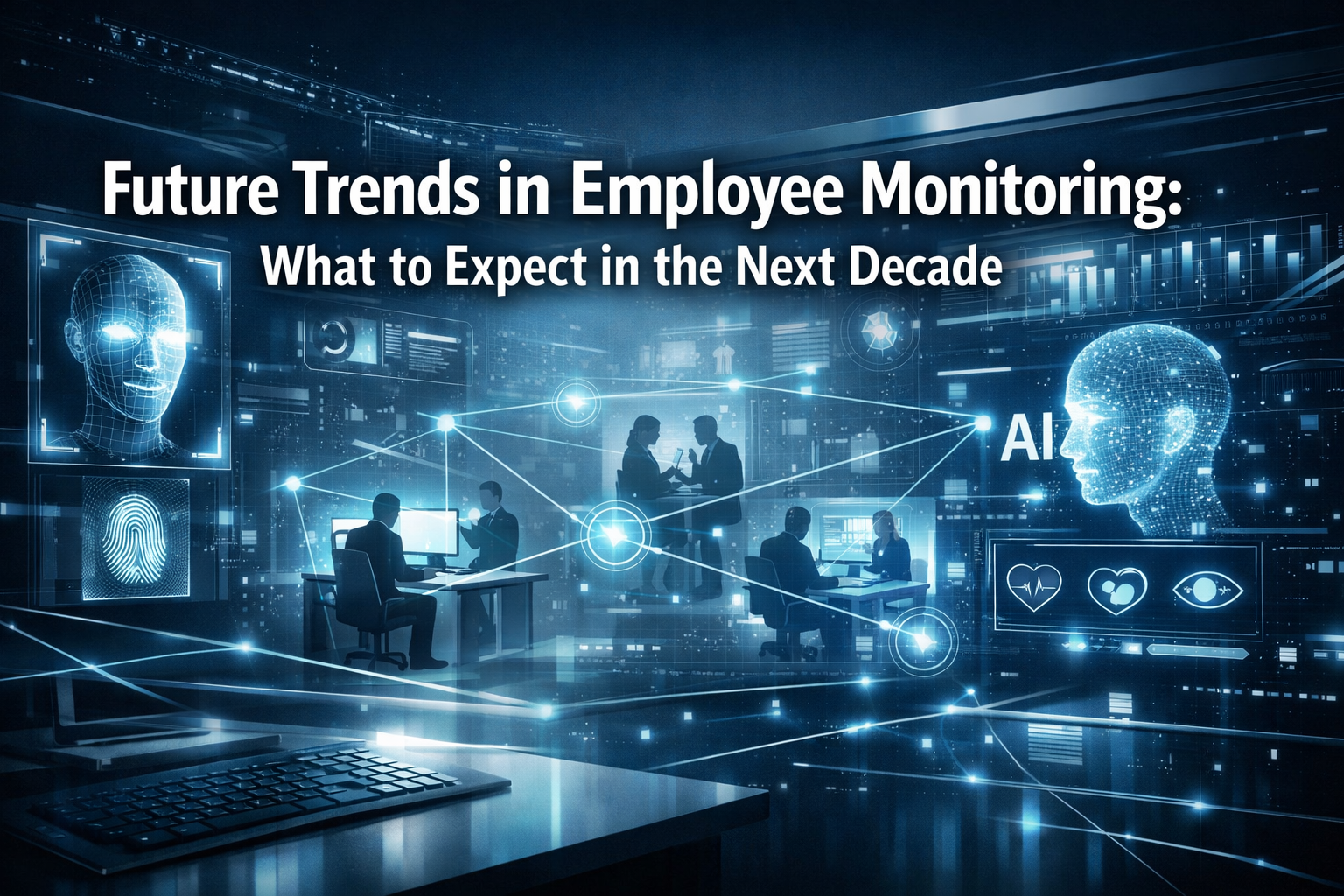
The landscape of work is undergoing a profound transformation. As remote work continues to expand across industries, employee supervision methods are rapidly evolving. By 2025, experts predict that 32.6 million Americans will be working remotely. This monumental shift has led to new technologies and innovative methods aimed at observing, evaluating, and enhancing remote employees’ efficiency. Understanding the **Future Trends in Employee Monitoring: What to Expect in the Next Decade** is crucial for businesses aiming to adapt and thrive.
The future of remote employee monitoring will likely bring significant changes, shaped by new tools, heightened concerns around privacy, and a growing need for flexibility in how businesses manage their remote teams. In the next ten years, we may see a sophisticated mix of advanced technologies and a more human-centric approach to remote employee monitoring methods that not only maintain efficiency but also prioritize employee well-being. This article will thoroughly explore the key trends shaping the future of remote employee monitoring.
Key Takeaways
Non-Intrusive Tools: Expect a significant shift towards monitoring solutions that focus on outcomes and tasks completed rather than minute-by-minute activity tracking, respecting employee privacy.
AI-Driven Insights: Artificial intelligence will become central to analyzing productivity, identifying trends, and automating administrative tasks, providing deeper, more actionable insights into remote performance.
Real-Time Feedback: Future monitoring systems will integrate instant, data-driven feedback loops to support employee growth, enabling faster adjustments and personalized development plans.
Well-Being Focus: Monitoring tools will increasingly incorporate features to identify signs of stress or burnout, prompting breaks and potentially integrating with wellness programs to support employee mental health.
Ethical Data Practices: Stricter privacy regulations and a stronger emphasis on ethical data collection will drive transparency and give employees greater control over their performance data.
The Rise of Non-Intrusive Monitoring Tools
One of the most significant challenges in the monitoring of employees in the workplace process is striking the right balance between evaluating their performance and respecting their privacy. With the undeniable rising trend of remote work, non-intrusive tools for monitoring will gain considerable popularity. Upcoming monitoring tools in the next decade are not likely to record every keystroke or capture images from employees’ screens all the time; instead, they might concentrate more on results achieved and tasks accomplished. These sophisticated systems will track overall productivity and project milestones without the constant need to monitor every single action in real time.
For instance, future solutions for employee monitoring might shift their focus dramatically to examining the quality of the work delivered, the successful completion of projects, and contribution to team goals, rather than merely how many hours were logged or specific applications used. This strategic move to a goal-focused, outcome-based method of supervision helps employees retain their independence and autonomy while simultaneously providing employers with clear, quantifiable signs of performance. Moreover, numerous businesses will likely adopt tracking tools that genuinely align with what employees anticipate and deem fair, thereby building trust and lessening feelings related to excessive surveillance. Employers who proactively accept and implement non-invasive tools can foster a more open, transparent, and ultimately more efficient workplace culture. This approach creates a win-win scenario, where productivity is maintained and employee morale is boosted by a clear respect for personal space and privacy.
The evolution of these tools will be driven by a demand for solutions that offer insights without generating resentment. Imagine tools that provide an overview of project progress, collaboration patterns, and task completion rates, all while keeping individual keystrokes or screen captures out of the picture. Such systems might analyze data like:
Project Milestones: Tracking the completion of specific project phases or deliverables.
Communication Flow: Observing collaboration efficiency in team communication platforms (e.g., number of active discussions, response times within work-related channels).
Application Usage Trends: Identifying trends in how employees engage with necessary work applications, not to police individual use, but to understand overall tool adoption and potential bottlenecks.
Document Version Control: Monitoring progress on shared documents and creative assets without constant real-time screen access.
This shift underscores a move away from “big brother” tactics towards a more mature, trust-based employer-employee relationship, where technology acts as a supportive framework rather than a disciplinary one. By prioritizing outcomes over constant oversight, companies can empower their remote workforce, allowing them to manage their time and methods more flexibly, knowing that their contributions are valued and measured fairly.
“The future of employee monitoring isn’t about watching every click; it’s about understanding impact and empowering productivity with respect for privacy.”
AI-Driven Insights for Productivity Enhancement in Employee Monitoring
Artificial intelligence, also known as AI, is anticipated to become a leading figure in observing employee activities, providing a profoundly advanced method for assessing productivity levels. Systems supported by AI can monitor how employees interact with various job assignments; they examine trends in work processes, communication styles, and time administration methods with unparalleled sophistication. This deep analytical capability positions AI as a cornerstone of **Future Trends in Employee Monitoring: What to Expect in the Next Decade**.
Unlike traditional supervision focused on basic time tracking or logging hours, upcoming AI-driven platforms will provide deeper, more nuanced insights into how remote employees perform specific tasks. This rich, granular data can assist employers in recognizing potential problem areas, giving focused responses to performance challenges, and creating tailored efficiency plans that are truly impactful. For example, AI might detect patterns indicating an employee is struggling with a particular type of task, or that a team’s communication style is hindering progress on a project.
Beyond just monitoring, AI will also provide invaluable help in making routine administrative tasks automatic. This automation allows employees to concentrate their precious time and energy on more creative, strategic, and ultimately more meaningful work. This pivotal shift could significantly boost job satisfaction and decrease fatigue by enabling individuals to focus on the more rewarding and impactful aspects of their roles. Imagine AI handling scheduling conflicts, organizing project files, or even drafting initial responses to common queries, freeing up human talent for higher-value activities. However, it is absolutely paramount that companies employ these AI systems transparently, ensuring employees fully understand how the data is collected, used, and how it ultimately benefits both them and the organization. Without clear communication, even the most beneficial AI tools can breed distrust.
The scope of AI in employee monitoring will extend beyond simple data collection. It will delve into predictive analytics, identifying potential issues before they become major problems. For example, AI could analyze:
Workload Distribution: Suggesting fairer task allocation to prevent burnout among team members.
Skill Gaps Identification: Pinpointing areas where employees might need additional training or resources based on performance patterns.
Collaboration Effectiveness: Analyzing communication patterns within teams to suggest optimized collaboration strategies.
Process Optimization: Identifying inefficiencies in workflows by analyzing how tasks move through different stages and suggesting improvements.
This evolution signifies a move towards a more intelligent, proactive form of management. Instead of merely reacting to problems, businesses can leverage AI to foresee challenges and implement solutions, fostering a more resilient and productive workforce. The ethical implementation of these powerful tools will determine their success, requiring a delicate balance between maximizing efficiency and protecting individual rights.
Real-Time Feedback Loops to Support Employee Growth
In the future, employee monitoring tools will evolve beyond mere oversight; they will actively aim to promote development by integrating instant feedback mechanisms. People who work from home often do not have immediate access to the spontaneous responses that naturally happen in a co-located workplace environment. This critical lack of instant feedback can make it challenging for them to accurately evaluate their performance or track their improvement trajectory. Sophisticated observation tools will fill this deficiency by providing immediate, data-based feedback directly to the employee. This marks a crucial aspect of the **Future Trends in Employee Monitoring: What to Expect in the Next Decade**.
With the help of automatic reports and personalized dashboards, employees can see their performance measurements immediately. This gives them clearer, objective insights into their strengths and specific areas for improvement. The continuous supply of feedback helps in making adjustments faster, which is incredibly useful for employees who work from different locations to line up with company targets more efficiently and effectively. For example, a tool might notify an employee if their response time to customer queries is dipping below a set benchmark, or if they’re consistently excelling in a particular software skill.
Additionally, when these platforms seamlessly integrate with learning and development systems, personalized training courses can be recommended automatically based on individual performance data. This fosters continuous professional growth and accelerates career advancement. Imagine a system that not only highlights a skill gap but immediately suggests a relevant online course or a mentor within the organization. This creates a powerful ecosystem for self-improvement.
This profound shift toward real-time, constructive feedback reflects a broader change in how employees are monitored. Instead of just observing them for accountability, the ultimate goal is to proactively back up their success with monitoring tools specifically created for that purpose, rather than solely recording what they do. This proactive, supportive approach transforms monitoring from a supervisory function into a developmental one.
Examples of real-time feedback mechanisms might include:
Automated Performance Reports: Daily or weekly summaries of key metrics (e.g., task completion rate, project progress, communication efficiency) delivered directly to the employee.
Micro-Learning Recommendations: Suggesting short training modules or articles based on identified areas for improvement.
Goal Progress Dashboards: Visual representations of an individual’s progress towards short-term and long-term goals.
Peer Recognition Prompts: Encouraging team members to provide positive feedback to colleagues based on observed contributions.
By turning monitoring into a continuous feedback loop, organizations can create a dynamic environment where employees feel supported, informed, and empowered to take ownership of their professional development. This not only enhances individual performance but also strengthens team cohesion and overall organizational agility.
Increased Focus on Employees’ Overall Well-Being
With the merging of professional and personal life that often characterizes virtual workplaces, it is expected that there will be an increasingly vital focus on using employee monitoring not just for productivity, but also to protect mental health and overall wellness. The upcoming years may well introduce monitoring systems that not only observe output but also actively highlight indications of stress or exhaustion. By evaluating trends in working behaviors, like too much overtime, irregular communication habits, or extended periods without activity during typical working hours, employers can spot possible mental health issues at an early stage. This is a compassionate yet strategic element within the **Future Trends in Employee Monitoring: What to Expect in the Next Decade**.
Future technology platforms might also include integrated wellness panels that motivate employees to take regular breaks or manage their work tasks more efficiently. Such tools could combine seamlessly with existing well-being apps, discreetly notifying workers to stand up, stretch, or participate in mindfulness activities. Some progressive companies may go a significant step further by providing direct, confidential access to mental health professionals or counseling services through their employee monitoring systems, thereby emphasizing the inextricable connection between sustained productivity and robust employee well-being.
Companies can make a more encouraging, supportive, and sustainable workplace by promoting long-term efficiency and contentment. This is achieved by actively dealing with employee health and mental wellness through thoughtfully designed surveillance systems. This approach transforms monitoring from a purely observational tool into a proactive support system.
Consider how these well-being features might manifest:
Work-Life Balance Indicators: Tools that analyze patterns of working hours, identifying individuals consistently working beyond standard hours or sending emails late into the night.
Burnout Risk Assessments: AI models that identify behavioral patterns (e.g., decreased engagement, increased errors, inconsistent work output) linked to potential burnout.
Proactive Break Reminders: Automated nudges to take short breaks, stand up, or engage in a quick mindfulness exercise, customizable by the employee.
Resource Access: Providing discreet links or direct access to EAPs (Employee Assistance Programs), mental health resources, or well-being coaches within the monitoring dashboard.
“Quiet Time” Scheduling: Allowing employees to schedule blocks of uninterrupted work time, and signaling their availability status to colleagues, reducing distractions.
This focus reflects a growing understanding among employers that a healthy workforce is a productive workforce. By integrating well-being into monitoring practices, businesses are not just being socially responsible; they are making a strategic investment in the long-term sustainability and success of their remote teams. The key will be to implement these features with utmost sensitivity, ensuring employee trust and privacy are always at the forefront.
Enhanced Data Privacy and Ethical Monitoring Practices
As more and more companies start to integrate sophisticated employee monitoring, it’s only natural for concerns about data privacy to escalate dramatically. In the future, rigid rules and increased attention to ethical practices in monitoring will unequivocally dictate how businesses use these powerful tools. Workers are becoming increasingly conscious and vocal about their privacy rights, so companies will have to change their approach by offering better clarity and transparency on the method they gather, store, and utilize this sensitive information. This unwavering commitment to ethics and privacy will define the **Future Trends in Employee Monitoring: What to Expect in the Next Decade**.
Future employee monitoring tools will probably integrate principles based on “privacy-by-design,” which inherently assures that data gathering is minimized to only what is absolutely needed for enhancing productivity, and that sensitive information is managed with extreme caution and robust security protocols. Firms not following these stringent methods might risk breaking trust among their staff members and face severe penalties from regulators, alongside significant reputational damage. We may also see the emergence of decentralized databases that allow employees greater control over their performance records, granting access to employers only when absolutely necessary and with explicit consent. This empowers employees with a sense of ownership over their data.
Alongside more stringent privacy rules, companies must establish straightforward, unambiguous ways of communicating that clearly explain the use of monitoring tools and how workers can choose not to participate in specific data-gathering features if they wish. It will be very important for ethical surveillance methods to uphold a positive, trusting bond between employers and remote employees, especially during this period when digital privacy is much valued and often legally protected. Open dialogue and mutual respect will be the bedrock of successful monitoring strategies.
Key aspects of enhanced data privacy and ethical monitoring practices will include:
Clear Policies and Consent: Companies will be required to have explicit, easy-to-understand policies about what data is collected, why, and for how long. Employees must provide informed consent.
Data Minimization: Collecting only the data strictly necessary for the stated purpose, avoiding superfluous or overly personal information.
Anonymization and Aggregation: Where possible, individual data will be anonymized or aggregated to protect privacy, especially for trend analysis.
Regular Audits: Independent audits of monitoring systems to ensure compliance with privacy regulations and ethical guidelines.
Employee Access and Control: Giving employees the right to access their own collected data, dispute inaccuracies, and potentially request deletion under certain circumstances.
Security Measures: Implementing state-of-the-art cybersecurity measures to protect sensitive employee data from breaches and unauthorized access.
Transparency in AI Algorithms: If AI is used, there will be pressure for transparency regarding how algorithms make decisions or identify patterns, to avoid bias and ensure fairness.
The ethical compass will guide the development and deployment of new monitoring technologies. Companies that prioritize privacy and ethical considerations will not only avoid legal pitfalls but also cultivate a more engaged, loyal, and productive workforce that feels respected and protected. This will be a defining characteristic of advanced employee monitoring in the coming decade.
Bottom Line
In the future, the way businesses monitor remote employees will undergo significant and transformative changes, largely driven by rapid advancements in AI and a growing emphasis on non-invasive tools. Simultaneously, there’s also an increasing, crucial interest in taking care of employee wellness as an integral part of productivity. As companies increasingly adopt and rely on remote work models, they must meticulously consider both the imperative for productivity checks and the paramount need to protect individual privacy. The successful navigation of these dual priorities will define the landscape of the **Future Trends in Employee Monitoring: What to Expect in the Next Decade**.
As we move forward, organizations must remain exceptionally flexible, adaptable, and innovative to these emerging trends to thrive sustainably in an increasingly remote and digitally connected world. The goal is not just to observe, but to empower, support, and foster a healthy, productive, and trusting remote workforce.
Actionable Next Steps for Businesses:
Review Current Monitoring Practices (2026): Assess existing tools and policies. Are they compliant with current privacy regulations? Do they align with ethical best practices?
Investigate Non-Intrusive Technologies: Research and pilot new monitoring solutions that focus on outcomes, project milestones, and aggregate data rather than individual micro-activities.
Explore AI Integration: Begin exploring how AI can automate administrative tasks, provide predictive insights, and enhance productivity without compromising privacy.
Prioritize Employee Well-being: Consider integrating wellness features into HR tech stacks. Develop strategies to proactively identify and address signs of stress or burnout among remote employees.
Foster Transparency and Trust: Communicate openly and clearly with employees about any monitoring tools. Establish clear policies and ensure employees understand their rights regarding data privacy.
Stay Updated on Regulations: Continuously monitor evolving data privacy laws and ethical guidelines related to employee monitoring to ensure ongoing compliance.
Gather Employee Feedback: Regularly solicit input from your remote workforce on their comfort levels with monitoring tools and how these tools could better support their work and well-being.
Train Managers: Equip managers with the skills and understanding needed to utilize new monitoring tools effectively and ethically, focusing on support and development rather than punitive oversight.
By proactively addressing these areas, businesses can strategically prepare for the evolving landscape of employee monitoring, transforming it from a mere oversight function into a powerful tool for growth, efficiency, and well-being in the next decade.
Frequently Asked Questions about Employee Monitoring Trends
What are non-intrusive monitoring tools?
Non-intrusive monitoring tools are systems designed to track employee performance by focusing on outcomes, task completion, and project milestones rather than constant, real-time surveillance of individual activities like keystrokes or screen captures. They aim to respect employee privacy while still providing valuable productivity insights.
How will AI impact employee monitoring in the next decade?
AI will significantly impact employee monitoring by providing deeper insights into work patterns, communication styles, and time management. It will automate administrative tasks, identify skill gaps, predict potential issues like burnout, and offer personalized recommendations for productivity enhancement and training.
Why is real-time feedback becoming important in employee monitoring?
Real-time feedback is crucial because remote employees often lack the immediate, spontaneous feedback found in traditional offices. Future monitoring tools will provide instant, data-driven insights into performance, allowing for quicker adjustments, continuous learning, and personalized professional development, fostering growth rather than just oversight.
What role will employee well-being play in future monitoring?
Employee well-being will play a central role, with monitoring systems designed to identify signs of stress, exhaustion, or overwork. These tools might prompt breaks, integrate with wellness apps, and even provide access to mental health resources, recognizing the direct link between well-being and sustained productivity.
How to Prepare for Future Trends in Employee Monitoring: What to Expect in the Next Decade
Step 1: **Review and Update Current Policies (2026)**Assess your existing employee monitoring tools and internal policies. Ensure they are compliant with current privacy regulations and align with ethical best practices. Identify areas where your approach might be too intrusive or lack transparency.
Step 2: **Research and Pilot Non-Intrusive Technologies**Actively investigate new monitoring solutions that prioritize outcomes, project milestones, and aggregate data over individual micro-activities. Consider piloting these tools with a small team to evaluate their effectiveness and employee acceptance.
Step 3: **Explore AI Integration for Insights and Automation**Begin exploring how AI can be integrated into your HR and operations. Focus on using AI to automate routine administrative tasks, provide predictive insights into productivity patterns, and identify skill gaps, all while maintaining ethical data handling.
Step 4: **Prioritize Employee Well-being and Provide Feedback**Develop strategies to proactively identify and address signs of stress or burnout among remote employees. Invest in systems that offer real-time, constructive feedback for continuous learning and development, and consider integrating wellness features into your HR tech stack.
Step 5: **Foster Transparency, Trust, and Continuous Learning**Communicate openly and clearly with employees about any monitoring tools, ensuring they understand their rights and how data is used. Train managers to use these tools ethically, focusing on support and development. Stay updated on evolving data privacy laws and ethical guidelines to maintain compliance and trust.
Key Terms in Future Employee Monitoring
Privacy-by-Design
An approach to system engineering that aims to build privacy directly into the design and operation of IT systems, networked infrastructure, and business practices from the outset, ensuring data protection is fundamental rather than an add-on.
Non-Intrusive Monitoring
Employee monitoring methods that prioritize respect for privacy by focusing on high-level outcomes, project progress, and aggregated performance metrics rather than detailed, constant observation of individual keystrokes, screen activity, or personal communications.
AI-Driven Insights
Analytical conclusions and actionable recommendations generated by artificial intelligence algorithms that process large datasets of employee work patterns, communication, and task interactions to identify trends, optimize processes, and enhance productivity.
Real-Time Feedback Loops
Automated or near-instantaneous systems that provide employees with continuous data-driven feedback on their performance, progress towards goals, and areas for improvement, enabling immediate adjustments and fostering ongoing professional development.
Employee Well-being Monitoring
Monitoring practices that extend beyond productivity metrics to include indicators of employee mental health and work-life balance, such as overtime patterns or irregular work habits, with the aim of identifying potential stress or burnout and offering support.
Marcin Wieclaw, the founder and administrator of PC Site since 2019, is a dedicated technology writer and enthusiast. With a passion for the latest developments in the tech world, Marcin has crafted PC Site into a trusted resource for technology insights. His expertise and commitment to demystifying complex technology topics have made the website a favored destination for both tech aficionados and professionals seeking to stay informed.