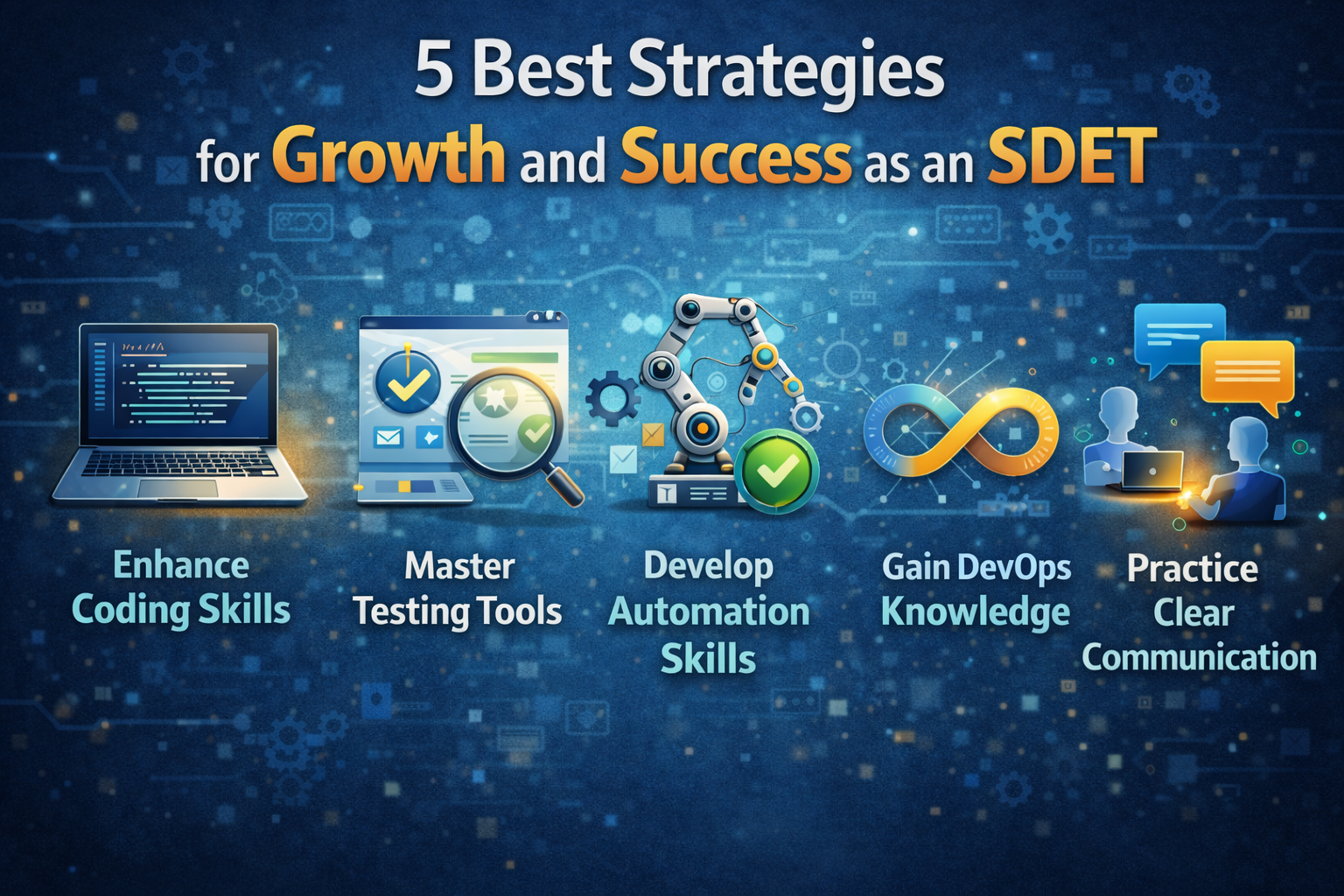
5 Best Strategies for Growth and Success as an SDET in 2026
The tech landscape is ever-evolving, and nowhere is this more apparent than in the critical role of the Software Development Engineer in Test (SDET). You might have an idea who the SDETs are and the essential skills that are required to become an SDET. However, just when you have got the role of an SDET (which you always wanted) your journey won’t end there. Though Software Development Engineers in Test (SDETs) are one of the most important parts of the tech industry, there are certain behaviors or should we say “strategies” that are crucial to gaining more success in the role of SDET. This article delves into the 5 Best Strategies for Growth and Success that will elevate an SDET from competent to truly indispensable in 2026.
Key Takeaways
Continuous Skill Enhancement: Beyond initial certification, consistently hone development skills, focusing on advanced programming and clean code practices.
Holistic Perspective: Look beyond just testing and development; understand business objectives, user experience, and risk assessment to provide greater value.
Strategic Automation: Master the art of intentional automation, discerning when and where to automate for maximum impact rather than automating everything.
Diversified Toolset: Continuously explore and master new automation tools, adapting solutions to problems rather than forcing problems to fit familiar tools.
Enhanced Collaboration: Actively engage with manual testers, developers, business analysts, and product owners to build comprehensive and effective testing strategies.
The Evolving Role of the SDET in 2026
In today’s fast-paced software development world, the SDET is no longer just a tester who can code. They are pivotal figures, bridging the gap between development and quality assurance, ensuring not only that software works, but that it delivers exceptional value. To truly thrive and achieve the 5 Best Strategies for Growth and Success, an SDET must embrace continuous learning, strategic thinking, and collaborative prowess. The journey to becoming a great SDET is a marathon, not a sprint, and these strategies are your training plan.
1. Sharpen Your Development Skills: The Foundation for Growth
Learning about popular testing APIs is crucial to becoming an SDET for sure. While you can learn from platforms like WEDEVX’s SDET certification program, you shouldn’t just rely on learning for once. Even if you choose to learn from some other platform, you will be suggested to have a better grip on software development skills as well. If your goal is to become more proficient in the field, then have a firm grip on programming logic and concepts.
The later stages of your job, especially for larger projects from bigger tech companies, are more focused on object-oriented programming, more structured decisions, and data structures alongside structured concurrency. You should focus on clean coding practices along with design patterns as they play an important role in maintenance, reusability, and extendability.
Why Continuous Development Skill Improvement is Crucial:
Complex Systems: Modern applications are intricate. A deep understanding of development principles allows SDETs to build more robust and scalable automation frameworks.
Debugging Prowess: Strong development skills enable quicker identification and debugging of issues within both application code and test automation code. This reduces downtime and accelerates the development cycle.
Code Reviews: Participating in code reviews with developers becomes more impactful. SDETs can provide valuable feedback on code quality, testability, and potential pitfalls from a developer’s perspective.
Framework Contribution: SDETs with strong development skills are not just consumers of frameworks but contributors. They can enhance existing frameworks, integrate new tools, and propose architectural improvements, solidifying their role as technical leaders.
Embracing New Paradigms: As new programming languages, frameworks, and architectural patterns emerge (e.g., microservices, serverless), a strong development foundation allows SDETs to quickly adapt and apply their skills to these new domains.
💡 Pro Tip: Dedicate a few hours each week to personal coding projects outside of work. This could involve contributing to open-source projects, learning a new programming language, or building a small application. Practical application solidifies theoretical knowledge.
2. Look Beyond Testing and Development: The Holistic SDET Approach
Software testing and quality assurance are undoubtedly one of the most important parts of the software development cycle. However, these days quality assurance is more than important, and it is a strategy for the organization. It is apart from the regular testing that is conducted to validate. As an SDET, you will need to understand and pay attention to identify the risks and problems within an application or software. Just like manual testers, the SDETs should assess the software according to the user’s point of view to provide a better user experience for human users.
Furthermore, the business stakeholder perspective should not be overlooked. It can significantly boost their efficiency and productivity. This perspective requires them to understand that they don’t need entire technical downloads and test codes. Stakeholders always look for the big picture, so you should be providing this during key meetings and presentations. This will put both parties on the same platforms and they will understand the same language.
Understanding the Broader Impact:
User Experience (UX) Focus: An SDET who understands user workflows and pain points can design more effective tests that truly reflect real-world usage scenarios. This goes beyond functional correctness to ensure usability and satisfaction.
Business Acumen: Knowing the “why” behind features and understanding how they contribute to business goals allows an SDET to prioritize tests, identify critical paths, and communicate risks in a language that resonates with leadership. This is one of the 5 Best Strategies for Growth and Success that elevates your role.
Risk Assessment: Proactively identifying potential risks—not just technical bugs but also business-impacting issues—allows SDETs to guide testing efforts towards areas of highest concern, maximizing the impact of their work.
Effective Communication: Translating complex technical details into clear, concise, and business-relevant insights is a hallmark of a valuable SDET. This fosters better decision-making across teams.
Security & Performance: Beyond functional testing, a holistic SDET considers security vulnerabilities, performance bottlenecks, and accessibility standards early in the development lifecycle, preventing costly rework later.
💬 Thought Leadership: “An SDET who only sees code and tests is missing half the picture. The true value lies in understanding the user’s journey and the business’s mission.”
3. Understanding Intentions: Strategic Automation for Growth
Amateur SDETs who have just learned automation will go for automating every project, or any project that can be automated. This is because they believe that automating every bit of the project is better without knowing the consequences.
However, eliminating manual testing in this way isn’t possible. Experienced SDETs understand that blindly going for automation of projects can be risky. Fully automating the app testing can cause more problems than it solves. This is the reason why they intentionally make decisions to automate their tests and ensure that their selections align with their end goal. This deliberate approach to test automation is a cornerstone of the 5 Best Strategies for Growth and Success.
The Art of Intentional Automation:
Automation Strategy
Description
Benefits
Risks of Blind Automation
High ROI Tests
Automate tests that are repetitive, stable, high-risk, or critical to core functionalities.
Saves time, reduces human error, provides quick feedback on critical areas.
High maintenance, false positives, slow feedback loops.
Early Automation
Introduce automation at unit and integration levels as early as possible in the development cycle.
Over-reliance on automation, missing subtle UX issues.
Blindly automating everything can lead to a bloated, fragile, and difficult-to-maintain test suite that ultimately slows down the release cycle rather than accelerating it. A truly proficient SDET understands the equilibrium between speed, coverage, and stability.
4. Simplify and Automate Your Product’s Tech Setup: Focusing on Reliability
Automating the software at the UI layer can be a risky task according to seasoned SDETs. This is the reason they do it only when it is crucial, and they do it by sparing it from the rest. They understand that they should be relying on the more reliable parts of the software to automate for better results.
They will always look for the part of the software that will help them to conduct faster target testing. Unit and service layer testing is a good choice according to them, and they won’t even hesitate to conduct any. This will require them to opt for having better knowledge of multiple knowledge tools and experience to use them accordingly. This strategic approach to test layer automation is a key component of the 5 Best Strategies for Growth and Success.
The Testing Pyramid and Beyond:
The traditional testing pyramid advocates for a large number of fast, reliable unit tests at the base, fewer integration/service tests in the middle, and a small number of slow, brittle UI tests at the top.
Unit Testing: These tests verify individual components or functions in isolation. They are fast, reliable, and provide immediate feedback to developers. SDETs can significantly contribute by helping developers write better unit tests or by creating frameworks that simplify unit test creation.
Service Layer Testing (API Testing): This involves testing the APIs (Application Programming Interfaces) that allow different parts of an application to communicate. API tests are faster and more stable than UI tests, as they bypass the user interface, making them ideal for validating business logic and data flow.
UI Layer Testing: While necessary for end-to-end validation, UI tests are inherently more fragile due to constant changes in the user interface. Seasoned SDETs minimize UI automation, focusing on critical user journeys and supplementing with exploratory manual testing.
🚀 Actionable Insight: Invest time in mastering tools and techniques for API testing (e.g., Postman, Rest Assured, Karate DSL). These skills are highly valued and provide a significant return on investment in terms of testing efficiency.
5. Explore New Automation Tools: Expanding Your Arsenal
While opting for SDET certification, you will learn about at least one automation tool. However, becoming a proficient SDET requires you to be familiar with different automation tools. Continuously expand your toolset experience by learning their importance and working. Several forums often feature inquiries about repurposing tools like Selenium WebDriver for varied tasks.
Professional SDETs will understand and learn to assess them according to their problem. Rather than fitting every challenge to a familiar tool, they select tools based on specific needs. This enhances their problem-solving mind and teaches them how to think out of the box, reinforcing the 5 Best Strategies for Growth and Success.
The Ever-Expanding Tool Landscape:
The world of test automation tools is vast and constantly evolving. Sticking to just one tool, even a powerful one like Selenium, can limit an SDET’s effectiveness.
Beyond UI Automation: Explore tools for performance testing (e.g., JMeter, LoadRunner), security testing (e.g., OWASP ZAP, Burp Suite), mobile testing (e.g., Appium, Espresso, XCUITest), and cloud-native testing.
Test Management & Reporting: Familiarize yourself with test management systems (e.g., Jira with Zephyr, TestRail) and reporting frameworks (e.g., Allure, ExtentReports) to effectively track and communicate testing progress.
CI/CD Integration: Understand how to integrate automation into Continuous Integration/Continuous Deployment (CI/CD) pipelines using tools like Jenkins, GitLab CI, GitHub Actions, or Azure DevOps. This makes automation truly impactful.
Data Management: Learn about tools and strategies for test data management, which is crucial for creating realistic and repeatable test scenarios.
AI/ML in Testing: Keep an eye on emerging trends in AI/ML for test generation, self-healing tests, and predictive analytics in quality assurance.
🌐 Industry Trend: The rise of codeless and low-code automation tools is changing the entry barrier for automation. While professional SDETs still need strong coding skills, understanding these platforms can accelerate certain testing efforts.
Bonus Tip: Improve Collaboration – The Unsung Strategy for Success
One of the best things about experienced SDETs is that they know that they aren’t here only for automation. They will always focus on strategy before planning the automating their project. To strategize their automation, they will collaborate with other important individuals as well. This will include manual testers as well. The importance of manual testers still cannot be overlooked by them because they know about the application much deeper and they can help the SDETs to come up with the right strategy for testing. The collaboration with them is extremely useful in determining what tests should be automated.
Another valued collaboration is with the developers. Developers have dedicated knowledge about coding, so they can help the SDETs not only with the code base about the test automation but the additional layers suitable for testing. Collaboration with the business analysts and product owners also provides value to SDETs as well. They can help the students understand the importance of certain features in the application and how they will be used. They can provide comprehensive information about the customers and how they are using these features. All of this information is valuable in understanding and creating a strategy for automation.
Why Collaboration is Key:
Synergy with Manual Testers: Manual testers often possess invaluable domain knowledge and can identify subtle usability issues or edge cases that automated scripts might miss. Collaborating ensures comprehensive test coverage.
Partnering with Developers: Working closely with developers allows SDETs to understand the architecture, code changes, and potential integration points. This facilitates writing more stable and effective tests and even shifting left by testing features during development.
Aligning with Business Analysts/Product Owners: Understanding the “why” behind features and the intended user journey helps SDETs design tests that validate actual business value and user expectations, not just technical functionality.
Breaking Down Silos: Effective collaboration breaks down traditional “dev vs. QA” silos, fostering a shared sense of ownership for quality across the entire team.
Knowledge Transfer: Collaboration is a two-way street for knowledge transfer, allowing SDETs to learn from others and share their expertise in automation and testability.
🤝 Quote: “Alone we can do so little; together we can do so much.” – Helen Keller. This rings true for quality assurance in software development.
Importance of Becoming a Professional SDET in 2026
Yes, becoming an SDET can be a rewarding career, but becoming an SDET isn’t just enough. Your growth and success in becoming a proficient SDET matter a lot for you because:
You can bridge the gap between development and testing at a larger scale. As an SDET, you will be considered the software world’s Swiss army knife. You can code like a developer and test like a QA expert. However, mastering both will result in even more valuable projects on a larger scale. You can play a crucial role in a software development lifecycle.
Another thing is the multiple skills learning. Let’s face it, being a one-trick pony will not help you sustain in today’s competitive tech landscape. By becoming an SDET, you open doors to a plethora of opportunities. Whether you aspire to climb the corporate ladder, dive into cutting-edge technologies, or explore leadership roles, the SDET path provides a solid foundation for future growth.
The Impact of a Highly Skilled SDET:
Enhanced Product Quality: Proficient SDETs contribute to fewer bugs, better performance, and a superior user experience, directly impacting customer satisfaction and retention.
Faster Release Cycles: By implementing efficient automation and fostering collaboration, skilled SDETs enable quicker feedback loops and faster, more confident software releases.
Reduced Costs: Catching defects early through effective testing drastically reduces the cost of fixing them later in the development lifecycle or after deployment.
Innovation Catalyst: SDETs who understand both development and business needs can proactively identify areas for improvement, suggest innovative testing strategies, and even contribute to product features.
Career Advancement: The demand for highly skilled SDETs continues to grow in 2026. Mastering these strategies positions individuals for leadership roles, specialized senior positions, and greater earning potential.
Bottom Line
SDETs are valued individuals in the tech industry. However, more than just becoming the SDET is needed. You should keep learning and understand how well you can continue further to become not only proficient in SDET but also a profitable investment for the organization. So you should not only focus on your SDET certification with SDET boot camps but instead focus on consistent learning to grow better. Becoming a better self of your current version will help you enjoy greater advantages and the organization will want to retain your experience for the future.
The journey to mastering the 5 Best Strategies for Growth and Success as an SDET is ongoing. Embrace change, stay curious, and continuously seek opportunities to expand your knowledge and impact. Your dedication to these strategies will not only define your individual success but also contribute significantly to the overall quality and efficiency of the software products you help build.
Frequently Asked Questions About SDET Growth
Why is continuous development skill improvement crucial for an SDET in 2026?
Continuous development skill improvement allows SDETs to build more robust automation frameworks, quickly debug issues, provide valuable feedback in code reviews, contribute to framework enhancements, and adapt to new programming paradigms and architectural patterns like microservices or serverless computing.
How does looking beyond testing and development help an SDET grow?
By understanding user experience, business objectives, and overall risks, an SDET can design more effective tests, prioritize efforts based on business impact, communicate insights clearly to stakeholders, and proactively address security, performance, and accessibility concerns, thus providing greater value to the organization.
What is ‘strategic automation’ and why is it important for SDETs?
Strategic automation involves intentionally deciding when and where to automate tests based on factors like repetition, risk, and return on investment, rather than blindly automating everything. This prevents fragile, high-maintenance test suites and ensures automation truly accelerates the development cycle by focusing on high-impact areas.
Why should SDETs explore new automation tools beyond just one?
Exploring diverse automation tools enables SDETs to solve a wider range of problems effectively. Instead of forcing every challenge to fit a familiar tool, they can select the most appropriate tool for specific needs, enhancing their problem-solving capabilities across various testing domains like performance, security, mobile, and CI/CD integration.
How does collaboration with other teams benefit an SDET?
Collaboration with manual testers, developers, business analysts, and product owners provides invaluable insights into application functionality, code architecture, user needs, and business goals. This holistic understanding helps SDETs devise more comprehensive and effective automation strategies, foster shared ownership for quality, and accelerate knowledge transfer.
How to Implement These SDET Growth Strategies
Follow these steps to ensure continuous growth and success as an SDET:
Step 1:Commit to Continuous Development Skill Improvement. Regularly study advanced programming concepts, data structures, and algorithms. Practice clean coding and design patterns. Allocate time for personal coding projects or open-source contributions to apply and reinforce learned skills.
Step 2:Cultivate a Holistic Business and User Perspective. Actively seek to understand the ‘why’ behind features by engaging with product owners and business analysts. Analyze user journeys and incorporate user experience considerations into your test planning. Frame technical risks and issues in terms of business impact.
Step 3:Adopt Strategic Automation Principles. Before automating, evaluate the return on investment, stability, and criticality of tests. Prioritize automation at lower layers (unit, API) and use UI automation sparingly for core user flows. Design maintainable, robust automation frameworks.
Step 4:Expand Your Automation Toolset. Don’t limit yourself to one tool. Research and gain hands-on experience with tools for different types of testing (performance, security, mobile, cloud) and learn how to integrate them into CI/CD pipelines. Stay updated on emerging technologies like AI/ML in testing.
Step 5:Actively Improve Cross-Functional Collaboration. Engage regularly with manual testers to understand edge cases, developers for code insights, and business stakeholders for strategic alignment. Foster an environment of shared responsibility for quality across the entire development team.
Q&A About SDET Career Path
What are the core benefits of becoming a professional SDET in 2026?
Becoming a professional SDET in 2026 allows you to bridge the gap between development and testing, acting as a ‘software world’s Swiss army knife’. It opens doors to numerous opportunities, enabling you to climb the corporate ladder, engage with cutting-edge technologies, and explore leadership roles due to a solid foundation in diverse skills. Key benefits include enhanced product quality, faster release cycles, reduced costs, being an innovation catalyst, and strong career advancement prospects.
Key Terms Defined
SDET: Software Development Engineer in Test (SDET) is a professional role that combines the responsibilities of a software developer and a quality assurance engineer. SDETs are skilled in both writing code and designing, developing, and executing automated tests to ensure software quality and reliability. They play a crucial role in the software development lifecycle by integrating testing activities into the development process from the early stages.
Featured Automation Tool: Selenium WebDriver
Selenium WebDriver
Selenium WebDriver is an open-source tool widely used by SDETs for automating web browsers. It provides a powerful and flexible API that allows engineers to write automated tests for web applications across various browsers and operating systems. Its robust capabilities make it an essential component in developing scalable and reliable UI automation frameworks.
Supports multiple programming languages (Java, Python, C#, Ruby, JavaScript).
Marcin Wieclaw, the founder and administrator of PC Site since 2019, is a dedicated technology writer and enthusiast. With a passion for the latest developments in the tech world, Marcin has crafted PC Site into a trusted resource for technology insights. His expertise and commitment to demystifying complex technology topics have made the website a favored destination for both tech aficionados and professionals seeking to stay informed.